
Dental pain rarely waits for business hours. If something goes wrong at night or over a weekend in Torrance, here is what to do: manage pain and bleeding at home, go to a hospital emergency room if you have swelling that is spreading or any trouble breathing or swallowing, protect a knocked-out tooth and get help within 30 to 60 minutes if you can, and call your dentist as soon as the office opens.
At Haru Dental, we are open Monday to Friday from 9 AM to 6 PM and every other Saturday from 9 AM to 3 PM, and we hold same-day time in the schedule for urgent cases, whether or not you are already a patient. This guide explains what counts as an after-hours dental emergency, when the ER is the right call, first aid for the most common problems, and how to get seen quickly once we open.
Is There an After-Hours Dentist or a 24-Hour Dentist in Torrance?
Most dental offices, including ours, are not open 24 hours a day. When people search for an after-hours dentist or a weekend dentist late at night, what they usually need is three things: a way to stay comfortable and safe until morning, a clear sense of whether the problem belongs in a hospital, and a same-day appointment as soon as a dental office opens. If you are looking for an emergency dentist open on weekends, we are open every other Saturday from 9 AM to 3 PM.
It also helps to know what each option can actually do. A hospital emergency room is the right place for facial trauma, swelling that is spreading, or trouble breathing or swallowing, but it usually provides antibiotics and pain relief rather than dental treatment, and there is rarely a dentist on site. An emergency dentist treats the cause itself: draining an infection, re-cementing a crown, starting a root canal, or removing a tooth that cannot be saved.
What Counts as a Dental Emergency After Hours?
A dental emergency is any injury or infection that needs prompt care to stop pain, control bleeding, or save a tooth. Not everything that hurts is an emergency, and not everything urgent hurts, so here is roughly how we triage a call.
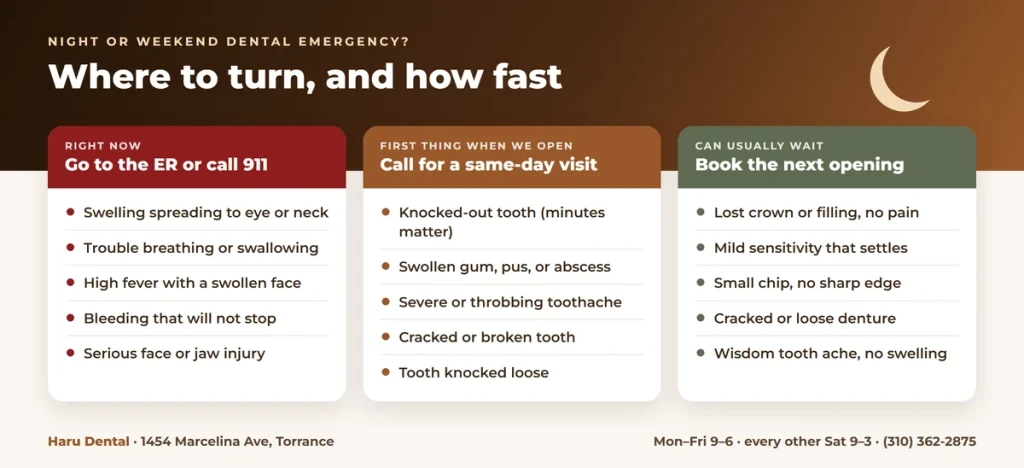
Call us as soon as we open, or first thing in the morning, when:
- A tooth has been knocked out, because the first 30 to 60 minutes matter most
- Your face, jaw, or gum is swollen, or there is pus around a tooth
- Pain is severe, throbbing, or keeping you awake
- A tooth is cracked, broken, or has a piece missing
- Bleeding has not slowed after 15 minutes of firm pressure
- A tooth has been knocked loose or pushed out of position
It can usually wait for the next available appointment when:
- A crown or filling has come out, but the tooth is not painful
- You have mild sensitivity to hot or cold that settles quickly
- A chip has no pain and no sharp edge
- A denture has cracked or stopped fitting
- Food was trapped between your teeth, and flossing has cleared it
- A wisdom tooth aches, but there is no swelling
When to Go to the ER for Tooth Pain
Some dental problems are hospital matters rather than dental ones. Go to the nearest emergency room, or call 911, if you notice any of the following:
- Swelling that is spreading across your face, toward your eye, or down your neck
- Any difficulty breathing or swallowing
- A high fever together with a swollen face or jaw
- Bleeding that will not stop despite firm pressure
- A serious injury to your face or jaw, such as from a fall, a sports collision, or a car accident
If you are treated in an ER for a dental problem, you will usually still need a dentist afterward to fix the tooth itself. Antibiotics and pain medication can calm an infection down, but they do not remove its source, so book a dental visit as soon as possible.
What to Do Tonight: First Aid for Common Dental Emergencies
Until you can be seen, these steps can ease pain and protect the tooth. The American Dental Association’s dental emergency guide covers several of them too.
Severe toothache or unbearable tooth pain at night
Rinse your mouth with warm water, then floss gently to remove any food that may be trapped. An over-the-counter pain reliever, taken as directed on the label, and a cold compress on the outside of your cheek can help you get through the night. Keeping your head raised on an extra pillow often makes throbbing pain easier to manage. Never put aspirin directly on the gum or tooth, because it can burn the tissue. If the pain is severe or keeping you awake, call us first thing.
Knocked-out tooth
Pick the tooth up by the crown, the part you chew with, not the root. If it is dirty, rinse it gently without scrubbing. If you can, place it back in the socket and hold it there, or keep it moist in milk or between your cheek and gum. Time matters more here than anywhere else, and the first 30 to 60 minutes give the best chance of saving the tooth, so if it happens while we are closed, the nearest emergency room is often the fastest place to be seen. Bring the tooth with you, and call us as soon as we open. A knocked-out baby tooth is usually not put back in, but your child should still be checked.
Cracked, chipped, or broken tooth
Rinse with warm water, save any pieces you can find, and hold a cold compress against your face to keep swelling down. If a sharp edge is cutting your tongue or cheek, a small piece of sugar-free gum or dental wax from a pharmacy can cover it overnight. A painful or large break needs to be seen promptly, while a small chip with no pain can usually wait for the next available appointment. Our dental crowns page explains how a broken tooth is usually restored.
Temporary crown fell off, or you lost a crown or filling
Keep the crown somewhere safe and bring it with you. Avoid chewing on that side, and keep the area clean. A temporary dental cement from a pharmacy can often hold a crown in place overnight, but never use super glue or household adhesives, which can damage the tooth. If the tooth is not painful, this can usually wait for the next available appointment; if it hurts or part of the tooth has broken, call us first thing.
Swollen face or a tooth abscess
Swelling, a pimple-like bump on the gum, or pus around a tooth are signs of infection, and an abscess will not heal on its own. Rinse gently with warm salt water, take an over-the-counter pain reliever as directed, and do not try to squeeze or pop the bump. Call us as soon as we open. If the swelling is spreading, or you have a fever or trouble breathing or swallowing, go to the ER right away. Depending on the tooth, treatment may involve draining the infection, a root canal, or an emergency tooth extraction.
Bleeding that will not stop
Fold a clean piece of gauze, place it over the area, and bite down with firm, steady pressure for 15 minutes without checking. A damp tea bag can work in place of gauze. If the bleeding has not slowed after 15 minutes, call us, and if it is heavy and will not stop, go to the ER.
Broken denture
Keep all the pieces and avoid gluing it yourself, since household glue can make a professional repair harder or impossible. A cracked denture, or one that has stopped fitting, can usually wait for the next available appointment, and our dentures page covers repairs and replacements.
How to Get a Same-Day Emergency Visit at Haru Dental

If you have been searching for an after-hours dentist, the fastest route to treatment is usually a same-day slot the next morning. We hold same-day slots open every day for emergencies, and you do not need to be registered with us to use one. If your problem starts overnight or on a weekend, call (310) 362-2875 as early in the day as you can once we open, because that gives us the most room to fit you in. We are also open every other Saturday from 9 AM to 3 PM, so a problem that starts on a Friday night may not have to wait until Monday.
Here is what happens when you call. We work out how urgent the problem is on the phone, give you first-aid guidance for the meantime, and book you into a same-day slot where you need one. At the visit, we find out what is actually wrong before quoting anything, and the urgent visit often stabilizes the tooth, with any definitive repair booked separately. Our emergency dentist in Torrance page explains the process in more detail, and our guide to common dental emergencies covers what to do in the first few minutes.
We are at 1454 Marcelina Ave in Torrance, open Monday to Friday from 9 AM to 6 PM and every other Saturday from 9 AM to 3 PM.
What Does an Emergency Dental Visit Cost?
The cost depends on what is causing the problem and what it takes to fix it, which is why the first step is always an exam and diagnosis. Most insurance plans cover emergency care, and our team reviews your benefits and tells you the out-of-pocket figure before we start. CareCredit and in-practice payment options apply to emergency treatment too, and our insurance and payment options page lists what we accept.
Waiting it out usually costs more in the end. Painkillers can mask an infection that keeps spreading, and a tooth that could have been saved today may need to be removed next week.
How to Prevent Weekend Dental Emergencies
Many after-hours emergencies start as small problems that were easy to put off. A few habits lower the odds of spending a weekend in pain:
- Wear a mouthguard for contact sports and activities where falls are likely
- Do not chew ice, hard candy, or popcorn kernels, and never use your teeth to open packages
- Do not ignore a tooth that is sensitive or aching before a weekend, holiday, or trip; call while the office is open
- Keep a small kit at home with gauze, a small container with a lid, an over-the-counter pain reliever, dental wax, and our phone number
- Keep up with regular dental checkups, which catch cracks, decay, and loose fillings before they fail
If you are dealing with a dental problem right now, call us as soon as we open at (310) 362-2875, and we will do our best to see you the same day.
Frequently Asked Questions
Is there a 24-hour dentist in Torrance?
Most dental offices are not open 24 hours. Haru Dental is open Monday to Friday from 9 AM to 6 PM and every other Saturday from 9 AM to 3 PM, with same-day slots held for emergencies. For spreading swelling or trouble breathing or swallowing at night, go to the nearest emergency room.
When should I go to the ER for tooth pain?
Go to the ER, or call 911, if you have swelling that is spreading across your face or down your neck, any difficulty breathing or swallowing, a high fever with a swollen face, bleeding that will not stop, or a serious injury to your face or jaw.
Is a toothache an emergency?
It can be. Severe or throbbing pain, pain that keeps you awake, or pain with swelling needs prompt care, so call your dentist first thing. Mild sensitivity to hot or cold that settles quickly can usually wait for the next available appointment.
What should I do if my temporary crown falls off at night?
Keep the crown safe, avoid chewing on that side, and keep the area clean. A temporary dental cement from a pharmacy can often hold it overnight, but never use super glue. If the tooth is not painful, it can usually wait for the next available appointment.
How do I save a knocked-out tooth?
Hold the tooth by the crown, not the root, and rinse it gently if it is dirty. Place it back in the socket if you can, or keep it moist in milk or between your cheek and gum, and get professional care as quickly as possible, ideally within 30 to 60 minutes.
Can urgent care help with a toothache?
An urgent care clinic or ER can often help with pain and infection, but it usually cannot repair the tooth. You will still need a dentist to treat the cause, so book a dental visit as soon as possible.
Do you see new patients for dental emergencies?
Yes. You do not need to be registered with Haru Dental to be seen for an emergency. Call (310) 362-2875 as early in the day as you can, and we will fit you into a same-day slot where you need one.
How much does an emergency dentist cost?
It depends on the problem and the treatment needed, so the first step is an exam and diagnosis. Most insurance plans cover emergency care, and we tell you your out-of-pocket cost before treatment. CareCredit and payment options are also available.
This article is general information, not a diagnosis. If you have trouble breathing or swallowing, call 911 or go to the nearest emergency room.