
Root Canal Treatment in Torrance, CA — Saves the Tooth, Ends the Pain
A root canal removes the infected nerve from inside the tooth and seals it, so you keep your own root instead of losing the tooth. Done under full anesthetic — it relieves the toothache rather than causing one.
259 reviews from Torrance families
treated through the crown of the tooth
for most teeth
no implant, no bridge, no gap
What a Root Canal Actually Does
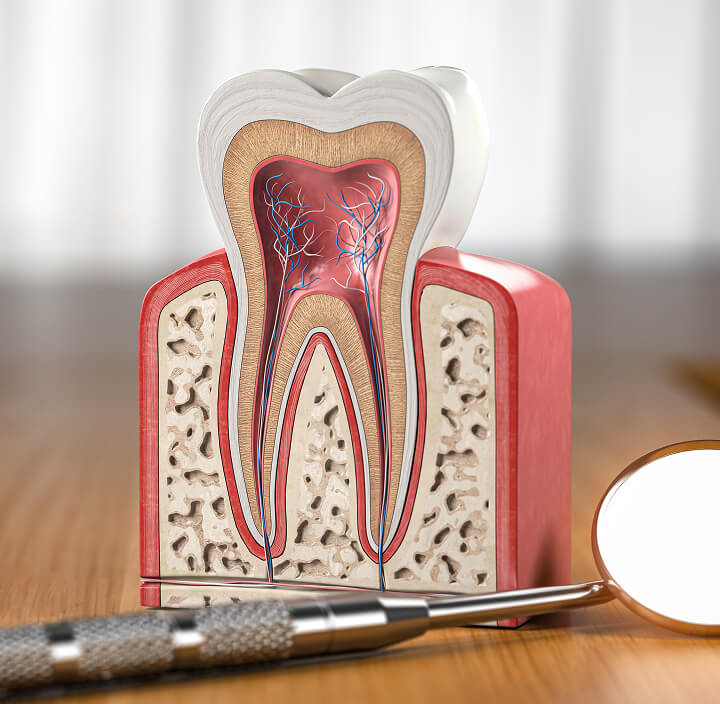
Inside every tooth is a chamber of soft tissue — the pulp — carrying the nerve and blood supply. When decay, a crack or a knock lets bacteria reach it, that tissue becomes infected. It cannot heal on its own, and the pressure inside a sealed chamber is what produces the throbbing that keeps people awake.
Root canal treatment removes that infected tissue, disinfects and shapes the narrow canals running down each root, and seals them. The tooth stays in your jaw doing its job. The alternative is not “wait and see” — it is extraction, because the infection carries on spreading into the bone.
Signs a Tooth Needs Root Canal Treatment
Not every toothache means a root canal, and some teeth that need one stop hurting entirely — which is the dangerous version. An X-ray and a couple of simple tests settle it.
Usually a root canal when…
- Pain lingers for more than a few seconds after something hot or cold
- It throbs at night or wakes you up
- Biting on that tooth hurts sharply
- The gum near it has a small bump or discharges
- The tooth has darkened compared with its neighbors
- There is swelling in the face or gum around it
Probably something else when…
- Sensitivity stops the moment the cold is gone — often exposed dentine
- It aches on waking with a tight jaw — that points at grinding
- Only one spot is sore and flossing clears it — trapped food
- The whole side aches with sinus pressure — sinus, not tooth
- A filling feels high — a bite adjustment takes minutes
If the nerve has already died the pain can disappear for weeks while the infection quietly spreads. Silence is not the same as recovery — get the X-ray.
What a Root Canal Costs in Torrance
Root canal cost depends mostly on which tooth it is. A front tooth has one canal; a molar can have four, and takes far longer to treat properly.
Priced by tooth position
Front, premolar and molar are three different jobs. You get the figure for your specific tooth after the X-ray, before treatment begins.
The crown is quoted with it
A back tooth almost always needs a crown afterwards. That is in the quote from the start — not a surprise a fortnight later.
Cheaper than replacing it
A root canal and crown normally cost less than an extraction plus an implant, and keep your own root. We will show you both numbers.
Root Canal vs Extraction vs Waiting
Once the pulp is infected there are only three paths, and one of them is not really a path.
Root canal
Clears the infection, keeps the root.
- Your natural root stays in the bone
- Usually one or two visits, then a crown
- Costs less than extraction plus an implant
Extraction
Removes the tooth and the problem with it.
- Right when the tooth is cracked below the gum
- Leaves a gap that needs filling in turn
- Bone under the gap begins to shrink
Leaving it
The option that removes your choices.
- Infection spreads into the bone around the root
- A savable tooth becomes an extraction
- Facial swelling can turn it into an emergency
Your Root Canal, Stage by Stage
The reputation is forty years out of date. With modern anesthetic and rotary instruments, most patients say it felt like having a long filling.
Numb & Isolate
The tooth is fully anesthetized and a rubber dam isolates it, so nothing from the rest of your mouth reaches the canals and nothing from the canals reaches you. This is the step that stops the pain, immediately.
Clean & Shape
A small access hole is made through the crown of the tooth. The infected pulp is removed, each canal is cleaned, disinfected and shaped, and the length is measured so the seal reaches the exact end of the root.
Seal & Restore
The canals are filled with a biocompatible material and the access sealed. A back tooth then gets a crown, because a root-treated molar is brittle and splitting one is what loses it.
The Week After a Root Canal
The deep pain goes as soon as the nerve is out. What remains is bruising-type tenderness around the ligament, and it settles quickly:
- Expect the tooth to feel tender to bite on for a few days — that is the ligament, not the infection
- Chew on the other side until the permanent crown is fitted
- Take over-the-counter anti-inflammatories as we advise for the first two days
- Avoid hard and sticky food while a temporary filling is in place
- Come back for the crown on schedule — this is the step people skip and it is the one that saves the tooth
- Brush and floss it exactly like any other tooth
A root-treated tooth that is crowned and looked after commonly lasts decades. The failures we see are nearly always teeth that never got their crown.
Why Torrance Patients Trust Us With a Root Canal
Anesthetic first, always
Nobody starts until you are completely numb, and we check rather than assume. A hot tooth can be stubborn to numb and there are techniques for that.
The crown is part of the plan
Restorative dentistry is the founder’s specialty, so the root canal is designed around the crown that follows it — quoted together, scheduled together.
Sedation for nervous patients
Nitrous oxide, oral and IV sedation are available. If dread is why this tooth has waited two years, see dental anxiety care.
Urgent cases seen the same day
An abscess is not something to sit on. Time is held daily for emergencies, a short drive from Gardena, Redondo Beach and Manhattan Beach.
Root Canal Questions, Answered
Root canal cost depends mainly on which tooth it is — a front tooth has a single canal, a molar can have four and takes considerably longer. The crown a back tooth needs afterwards is quoted at the same time rather than appearing later. Most insurance plans contribute, and we give you the out-of-pocket figure before treatment.
The treatment relieves pain rather than causing it. The tooth is fully anesthetized first, and the throbbing stops the moment the infected nerve is removed. Most patients describe it as a long filling. Tenderness to bite on for a few days afterwards is normal and settles.
One or two for most teeth. A straightforward front tooth is often done in a single appointment; a molar with several canals, or a tooth with active infection that needs medication between visits, takes two. The crown is a separate appointment after that.
The infection does not resolve on its own. It spreads out of the root tip into the surrounding bone, and what was a savable tooth becomes an extraction — and sometimes a facial swelling that turns into an emergency. If the pain has stopped, that usually means the nerve has died, not that the problem has gone.
Usually not, if the tooth is restorable. Keeping your own root maintains the bone and the bite, and a root canal plus crown normally costs less than an extraction plus an implant. Extraction becomes the better call when the tooth is cracked below the gum or too little structure remains to rebuild.
Because a root-treated back tooth is brittle. It has lost internal structure and its blood supply, and molar chewing force is high enough to split one — usually beyond saving. The crown wraps the tooth and holds it together. Front teeth with a small access hole can sometimes be restored with a filling instead.
That the treatment is carried out through the crown of the tooth rather than through the gum. A small access hole is made, the canals are cleaned from above, and nothing is cut open. Only a small minority of cases ever need surgery, and we would tell you plainly if yours was one.
Yes, and it is usually the fastest route out of pain. A very hot tooth can be harder to numb, so we allow extra time and use techniques for exactly that. Where there is significant swelling we may drain it and prescribe antibiotics first, then treat.
Yes. Our office on Marcelina Ave in Old Torrance is a short drive from Redondo Beach, Manhattan Beach, Hermosa Beach, Gardena, Carson, Lomita, Palos Verdes, Harbor City and San Pedro. Parking on site is free.
Related Treatments
Toothache That Will Not Settle?
Book an assessment at Haru Dental in Old Torrance. An X-ray and two quick tests tell us whether the nerve is involved — and if it is, we can usually get you out of pain the same day.
Opening Hours
- Mon–Fri: 9:00 AM – 6:00 PM
- Every other Saturday: 9:00 AM – 3:00 PM
- 1454 Marcelina Ave, Torrance, CA 90501
- (310) 362-2875