


If your dentist has told you that you need a root canal, you’re probably wondering two things: will it hurt, and how much will it cost? Root canal cost can feel like a mystery, especially when friends and websites quote very different numbers.
The truth is that the price depends on a few clear factors, and once you know them, it’s much easier to plan. In this guide, we cover average prices by tooth, what drives the cost, how insurance usually helps, and how to budget for the crown that often comes next.
At Haru Dental in Torrance, we give you your out-of-pocket amount before treatment starts.
What Is a Root Canal, and Why Is It Worth Saving the Tooth?
Inside every tooth is a soft area called the pulp. It holds nerves and blood vessels. When deep decay, a crack, or an injury lets bacteria reach the pulp, it can become inflamed or infected, which often causes a severe toothache, swelling, or sensitivity that lingers.
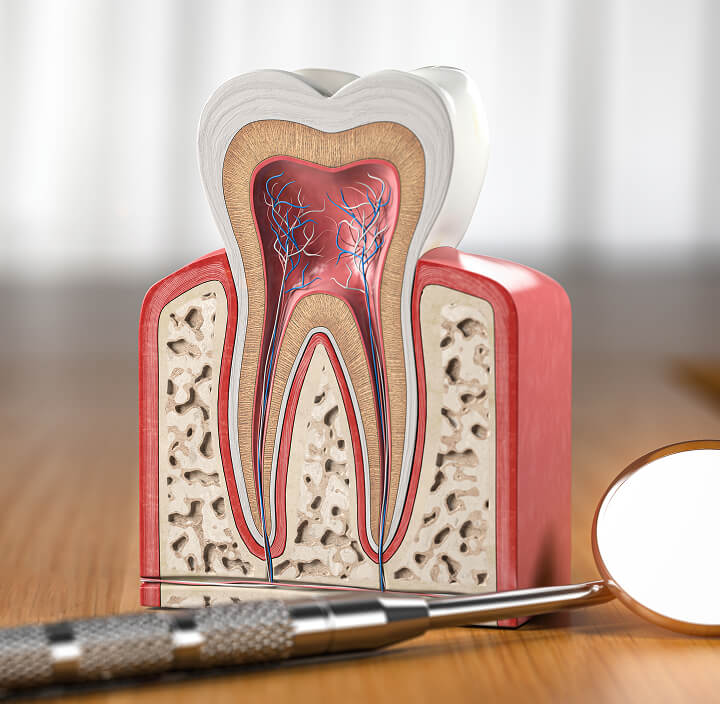

A root canal removes the damaged pulp, cleans and shapes the inside of the tooth, and seals it. The treated tooth can then keep working like a normal tooth. With modern numbing and instruments, most patients say it feels like having a long filling.
Saving your natural tooth is usually the right call for your bite and your long-term health. As you’ll see below, it also tends to cost less over time than pulling and replacing the tooth.
How Much Does a Root Canal Cost? Average Prices by Tooth
Nationally, the average cost of a root canal is about $978, with most fees falling between $679 and $1,733, according to a 2026 cost study published by CareCredit. Molars cost the most because they have more canals and take longer to treat.
| Tooth | National average | Typical range |
|---|---|---|
| Front tooth | $905 | $590 to $1,527 |
| Premolar | $1,023 | $691 to $1,827 |
| Molar | $1,220 | $833 to $2,171 |
Prices also vary by state. The same study puts the California average at $1,189, above the national figure. Delta Dental lists similar out-of-network fees of about $1,200 for a front tooth, $1,300 for a premolar, and $1,500 for a molar.
These figures cover the root canal alone. They don’t include the crown most back teeth need afterward, and they aren’t Haru Dental’s fees, so treat them as a starting point rather than a quote.
Root Canal Cost: What Drives the Price
There’s no single price for a root canal because every tooth is different. These are the biggest factors:
1. Which Tooth Needs Treatment
This is the biggest factor. Teeth have different numbers of root canals inside them:
- Front teeth usually have one canal. They’re the simplest and often cost the least.
- Premolars (the teeth just behind your canines) usually have one or two canals.
- Molars (the big back teeth) often have three or more canals. They take longer and usually cost the most.
On average, a molar root canal costs about $300 more than a front tooth.
2. How Complex the Tooth Is
Curved or narrow canals, extra canals, or a tooth that’s hard to reach can take more time and skill. An active infection may also mean more than one visit.
3. First Treatment or Retreatment
Redoing a root canal that was done before is usually more complex than a first-time treatment, so root canal retreatment often costs more.
4. Who Performs It
Many root canals are done by a general or restorative dentist. Very complex cases may be referred to an endodontist, a specialist in root canals, and specialist fees are often higher.
5. Where You Live
Dental fees tend to run higher in areas with a higher cost of living. That’s one reason the California average sits above the national one.
6. The Restoration Afterward
This is the part many people forget to budget for. After a root canal, the tooth needs to be sealed and protected, usually with a crown. We explain that cost below.
Root Canal and Crown Cost: Why the Crown Matters
After a root canal, a tooth can become more brittle. Back teeth take heavy chewing forces, so they almost always need a crown to protect them from cracking. A front tooth with only a small opening may sometimes be restored with a filling instead.
The crown adds a meaningful amount to the total. In CareCredit’s 2024 crown cost survey, a porcelain crown averaged $1,399 nationally ($2,331 in California), and a porcelain-and-metal crown averaged $1,114.
Added to the average molar root canal, that puts the root canal and crown cost at roughly $2,300 to $2,600 before insurance. When you’re comparing quotes, ask whether the price includes:
- The root canal itself
- A core build-up, which rebuilds the inside of the tooth to support a crown
- The crown
- X-rays and follow-up visits
At Haru Dental, the crown and any core build-up are planned and included in your quote from the start, so you see the full cost up front. Some teeth can even get a CEREC crown made in our office in a single visit. Learn more on our dental crowns page.
Root Canal Cost With Insurance
Most dental insurance plans help pay for root canals. Delta Dental notes that it’s common for plans to cover 50% to 80% of the cost of a root canal after the deductible has been met. Your exact share depends on how your plan is set up.
Here’s what to look for in your plan:
- How root canals are classified. Some plans list root canals as a “basic” service, which is often covered at a higher percentage. Others list them as “major,” which is usually covered at a lower percentage.
- How crowns are classified. Crowns are usually a “major” service, so your share may be higher for the crown than for the root canal.
- Your deductible and how much of it you’ve already met this year.
- Your annual maximum. A root canal and crown together can use a large part of it.
- Waiting periods for major services if you’re new to the plan.
- Pre-authorization. Some plans want to approve treatment before it starts.
As a simple example, if your plan pays 80% of a $1,000 fee and you’ve already met your deductible, your share would be about $200. The crown is often covered at a lower rate, so expect your share of it to be higher.
We accept many dental insurance plans, including Delta Dental, MetLife, Humana, and Ameritas. Our team checks your benefits and gives you your out-of-pocket amount before treatment. See our insurance and payment options for details.
How Much Is a Root Canal Without Insurance?
Without insurance, you pay the full fee. Using the national averages above, that’s often about $900 to $1,200 for the root canal alone, plus a crown if the tooth needs one.
You still have options to make it manageable:
- CareCredit financing lets you spread the cost into monthly payments.
- HSA or FSA funds can usually be used for root canals and crowns.
- Separate visits. The root canal and a lab-made crown are usually done at different appointments, so the cost is split across visits. Don’t wait too long for the crown, though, because an unprotected back tooth can crack.
If cost is a worry, tell us. We’ll give you your out-of-pocket figure before treatment, so there are no surprises.
Think you might need a root canal?
Root Canal vs Extraction: Which Costs More?
Pulling the tooth might seem like the cheaper choice at first. But a missing tooth usually needs to be replaced to keep your bite healthy and stop nearby teeth from shifting, which often means a bridge or a dental implant later.
Our guide to dental implant costs in Torrance puts a single implant, abutment, and crown at about $3,100 to $5,800 nationally. Compare that with roughly $2,300 to $2,600 for an average molar root canal and crown, and saving the tooth usually comes out ahead.
The American Association of Endodontists makes the same point: an extraction may look less expensive at first, but saving the natural tooth is generally the more cost-effective choice over time. If a tooth truly can’t be saved, an implant is a strong option, and our guide to when tooth extractions are necessary explains what to expect.
The Hidden Cost of Waiting
It’s tempting to put off a root canal, especially if the pain comes and goes. But an infected tooth doesn’t heal on its own. Waiting can lead to:
- A larger infection or a dental abscess
- More damage to the tooth, making it harder or impossible to save
- Swelling and pain that may need emergency care

Treating the tooth early is usually simpler, more comfortable, and less costly. If you have swelling or severe pain, call us right away. We hold time every day for urgent dental care.

How to Get an Accurate Root Canal Estimate
Online averages can only take you so far. To know your real number, you need three things:
- An exam and X-ray. This confirms whether you need a root canal and shows how many canals the tooth has.
- A benefits check. If you have insurance, your plan’s coverage, deductible, and annual maximum decide your share.
- A quote that includes the crown. Make sure the build-up and crown are in the estimate, not added later.
At Haru Dental, we cover all three before treatment begins, so you see one clear total.
What to Expect at Haru Dental
We use X-rays to check the tooth, then fully numb the area before treatment. A rubber dam keeps the tooth clean and isolated, and modern rotary instruments make the work smoother. Most root canals take one or two visits, depending on the tooth and whether there’s an infection.
If dental visits make you nervous, let us know. Our dental anxiety care page explains how we help patients feel at ease, and our non-surgical root canal page walks through the procedure step by step.
Have a toothache, or been told you need a root canal? Call us at (310) 362-2875 or request an appointment online. We’re at 1454 Marcelina Ave, Torrance, CA 90501.
Frequently Asked Questions
How much does a root canal cost?
Nationally, a root canal averages about $978, according to a 2026 CareCredit cost study. Front teeth usually cost the least (about $905 on average) and molars the most (about $1,220). We give you your exact out-of-pocket amount after your exam, before treatment begins.
How much is a root canal without insurance?
Without insurance, you pay the full fee, which averages roughly $900 to $1,200 nationally depending on the tooth. Most back teeth also need a crown. CareCredit financing and HSA or FSA funds can help spread out or offset the cost.
Does insurance cover root canals?
Most dental plans help pay for root canals, and Delta Dental notes that plans commonly cover 50% to 80% after the deductible. Your share depends on how your plan classifies root canals and crowns, your deductible, and your annual maximum.
How much does a root canal and crown cost?
At national averages, a molar root canal plus a crown comes to roughly $2,300 to $2,600 before insurance, depending on the crown material. At Haru Dental, the crown is included in your quote from the start, so you see the full cost before treatment.
Why does a molar root canal cost more?
Molars often have three or more canals, and they sit at the back of the mouth, where they’re harder to reach. That takes more time and skill, so molar root canals usually cost the most.
Do I need a crown after a root canal?
Back teeth almost always need a crown to protect them. A front tooth with a small opening may sometimes be restored with a filling instead.
Is a root canal cheaper than pulling the tooth?
An extraction costs less at first. But replacing the missing tooth with an implant or bridge usually makes the total cost higher than saving the tooth with a root canal and crown.
Does root canal retreatment cost more?
Usually, yes. Redoing an older root canal means removing the previous filling material and cleaning canals that may be harder to treat, so it often takes more time than a first-time root canal.