If you are missing most or all of your teeth, full mouth dental implants can feel like a fresh start. But once you start researching, the names get confusing fast. All-on-4, All-on-X, All-on-6, teeth in a day, snap-in dentures, zirconia bridges. They are not eight different treatments — they are different points on the same spectrum, and knowing which point you are being quoted for is the whole game.
This guide breaks down All-on-4 vs All-on-X in plain language: what the terms actually mean, how a dentist decides how many implants your jaw needs, what changes the price, and the questions worth asking before you sign anything. At Haru Dental in Torrance we walk patients through these choices every week.
What Are Full Mouth Dental Implants?
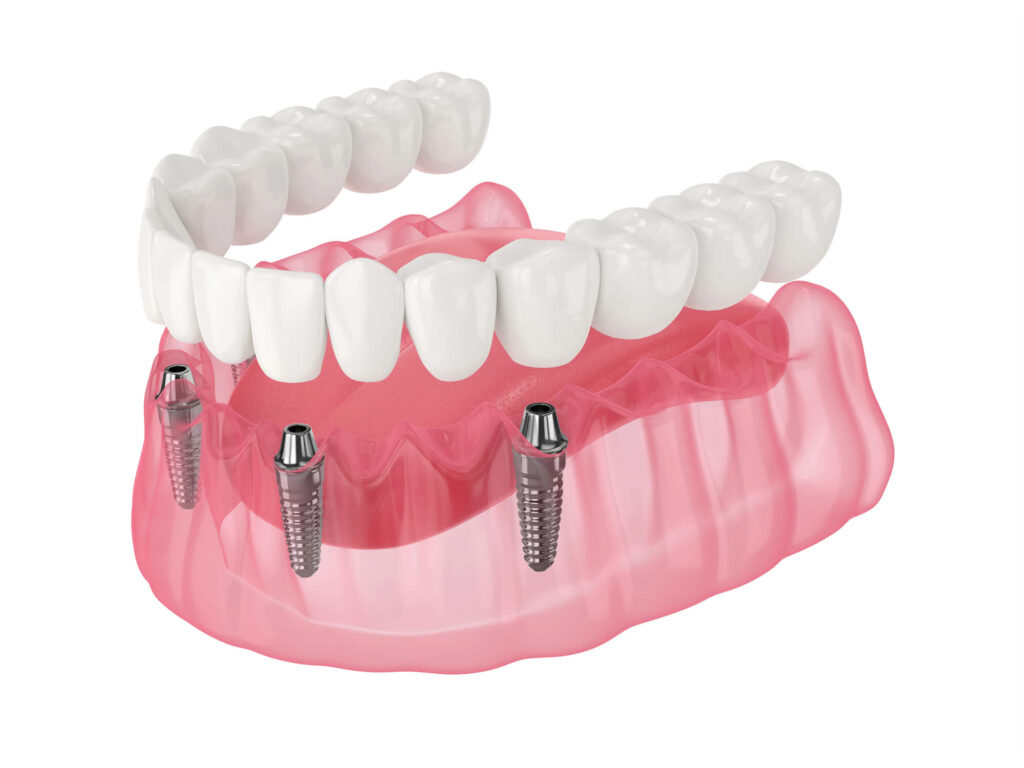
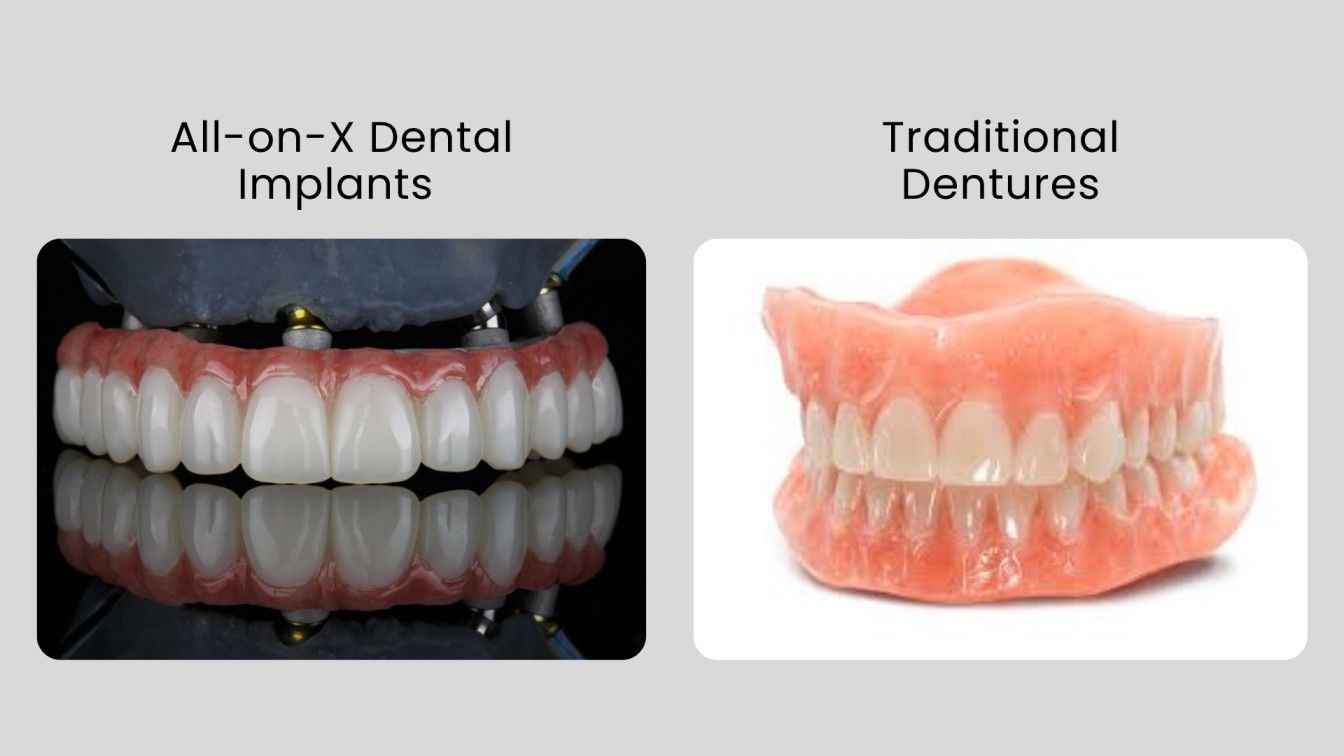
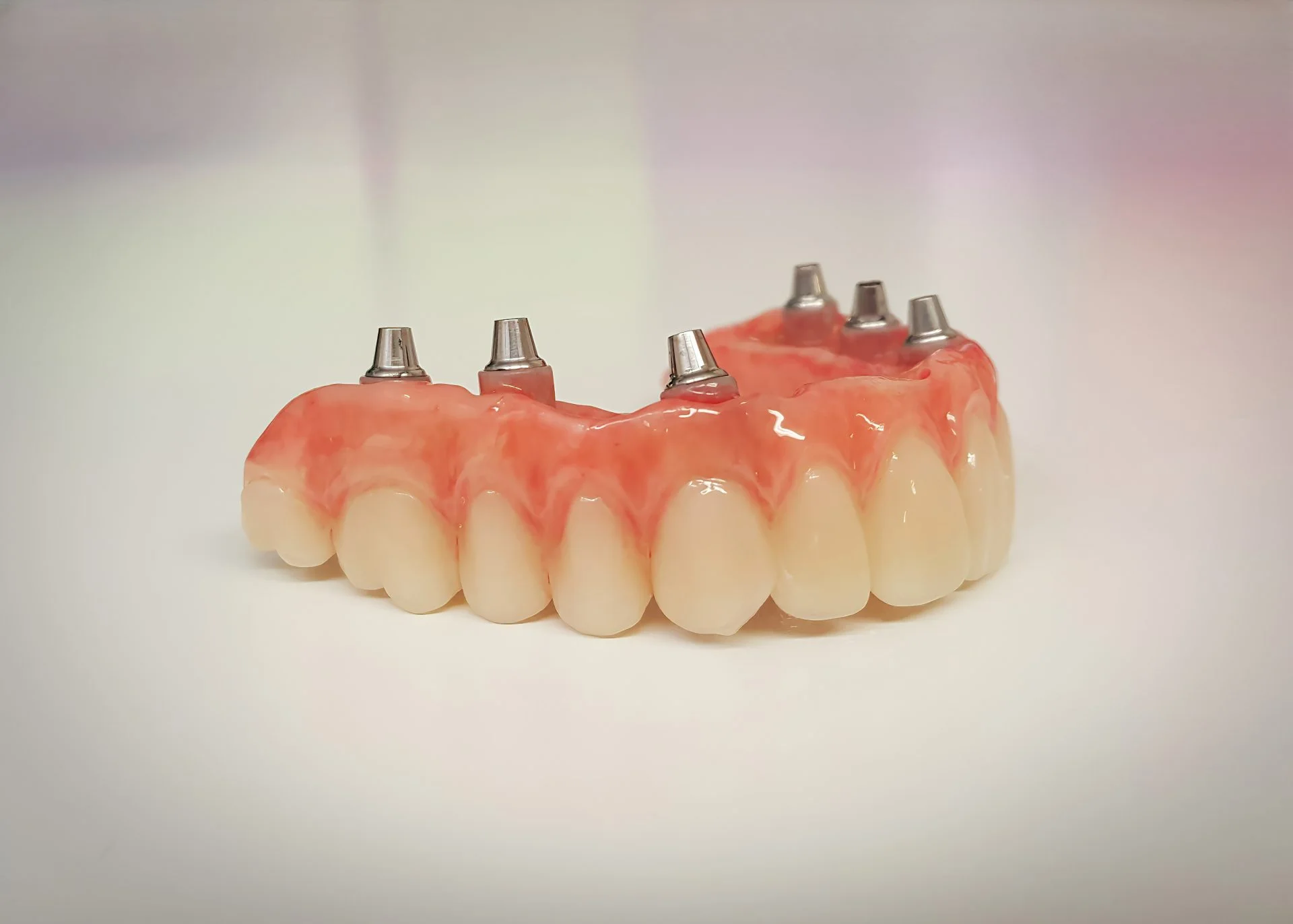
Full mouth dental implants — also called full-arch implants — replace an entire row of teeth using a small number of implants rather than one per tooth. Four to six titanium posts are placed in the jawbone and act as anchors for a single fixed bridge of teeth.
That is fundamentally different from a conventional denture, which rests on the gums and relies on suction or adhesive. Because implants integrate with bone, they hold your new teeth in place and help slow the bone loss that follows tooth loss. Our dental implants page covers how implants work in general; this article is about the full-arch version.
What Is All-on-4?
All-on-4 is a specific protocol: four implants per arch supporting one fixed bridge. Two are placed vertically at the front of the jaw, where bone is usually densest, and two are angled backwards at roughly 30 to 45 degrees.
That angle is the clever part. Tilting the rear implants lets them engage more bone and reach further back along the arch without entering the sinus in the upper jaw or crowding the nerve in the lower jaw. In practice it means many patients can avoid a separate bone graft or sinus lift, which removes months from the timeline and a significant amount from the cost.
All-on-4 is also the protocol most associated with same-day teeth. When the implants are stable enough at placement, a temporary fixed bridge can be fitted the same day, so you leave with teeth rather than with nothing. The final bridge comes later, once healing is complete.
What Is All-on-X?
All-on-X is the umbrella term. The X stands for however many implants your case actually needs — four, five, six, or occasionally more. So All-on-4 and All-on-6 are both types of All-on-X, not competitors to it.
The reason the term exists is that four is not always the right answer. Bone volume, bone density, bite force and whether you are treating one arch or two all push the number up or down. A practice that only offers All-on-4 is offering one answer to a question with several. Our All-on-X full mouth dental implants page explains how each case is planned.
All-on-4 vs All-on-6: How the Number Gets Chosen
Six implants spread chewing force across more anchor points, which can add stability and reduce stress on both the bridge and the individual implants over time. The trade-off is that six implants need more healthy bone to sit in, and the surgery is slightly more involved.
| Factor | All-on-4 | All-on-6 |
|---|---|---|
| Implants per arch | 4 | 6 |
| Bone required | Works with more limited bone | Needs more available bone |
| Grafting | Often avoids it | More likely to need it |
| Force distribution | Concentrated on four points | Spread across six points |
| Surgery | Simpler, usually shorter | Longer, more placement sites |
| Typical fit | Limited bone, simpler cases | Strong bone, heavy bite, larger arches |
Upper jaws often benefit from the extra support because upper bone is softer than lower bone. Someone who grinds their teeth may also be steered towards six. None of this is decided from a photograph — it comes out of a 3D scan.
Fixed Bridge or Snap-In Implant Dentures?
Full-arch replacement splits into two families, and this choice affects daily life more than the implant count does.
Fixed bridges — the All-on-4 and All-on-X approach. The bridge is screwed to the implants and stays in your mouth. You brush it, floss under it with a special threader or water flosser, and your dentist removes it periodically for a deep clean. It feels closest to natural teeth and gives the most chewing power.
Snap-in implant dentures — also called overdentures. These clip onto two to four implants and you take them out to clean. They are usually more affordable, they still stop the slipping that plagues conventional dentures, and they suit patients who want a simpler cleaning routine. Our implant retained dentures page covers this option in detail.
If you are weighing snap-in dentures against All-on-4, the honest framing is comfort and chewing power versus cost and simplicity. Both are a substantial step up from conventional dentures, and both preserve bone in a way that gum-borne dentures do not.
Materials: Acrylic or Zirconia?
The bridge that sits on your implants is not part of the implant decision, but it is part of the quote — and it is where two estimates for the same surgery can differ by thousands.
- Acrylic on a titanium bar. Lighter, more forgiving on the opposing teeth, and easy to repair or reline. Teeth can wear and stain over the years and may need replacing sooner.
- Zirconia (monolithic). Much harder, highly stain-resistant, and very lifelike. It costs more, and because it is rigid it needs precise planning and a well-balanced bite.
When you compare quotes, check which material each one includes. A cheaper number with acrylic is not automatically the worse deal — it depends on your bite, your budget and how long you want to go before the bridge is refreshed.
What the Timeline Actually Looks Like
- Consultation and 3D planning. Scans, photographs, a bite assessment and a review of your medical history. This is where the number of implants and the material are decided, and where you get a written treatment plan.
- Surgery day. Under local anesthesia or sedation, any remaining failing teeth are removed, the implants are placed, and — where stability allows — a temporary fixed bridge is fitted the same day.
- Healing and integration. Bone fuses to the implants over roughly three to six months. You are on a modified diet at first and seen regularly for checks.
- Final bridge. Once integration is confirmed, the temporary comes off and your definitive bridge in acrylic or zirconia is fitted and adjusted.
If teeth need to come out as part of the plan, that happens at the same visit as placement in most cases — see our page on tooth extractions for what that involves.
Who Is a Good Candidate
Full-arch implants tend to suit people who are missing most or all of the teeth in an arch, whose remaining teeth are failing, or who have worn dentures and are tired of the movement. Beyond that, a few things get assessed carefully:
- Bone volume and density. Angled implants stretch what is possible, but there is a floor. Severe upper-jaw loss sometimes calls for zygomatic implants anchored in the cheekbone.
- Gum health. Active gum disease is treated before implants go in.
- Smoking. It measurably raises the risk of implant failure. It does not automatically rule you out, but it changes the conversation.
- Uncontrolled diabetes or certain medications. Some bone medications and health conditions affect healing and need coordination with your physician.
- Grinding. Heavy bruxism usually means more implants, a stronger material and a night guard.
The American Academy of Implant Dentistry makes the same core point we do: ask about the provider’s implant training and how many full-arch cases they plan and place.
What Affects Your Plan and Your Cost
There is no honest flat price for full-arch implants, because the variables below move the number substantially:
- How many implants your arch needs — four, six or more
- Whether you are treating one arch or both
- The bridge material, acrylic on titanium or zirconia
- Whether extractions, a bone graft or a sinus lift are needed first
- Whether a temporary same-day bridge is included
- Sedation, 3D imaging and surgical guides
- Follow-up visits, adjustments and the final bridge, and whether they are inside the quote
That last point is the one that catches people out. Ask for the all-in figure in writing, and ask specifically what happens if a graft turns out to be necessary. Haru Dental offers a free, no-obligation implant consultation, we accept CareCredit, and our insurance and payment options page sets out how we handle benefits and financing.
How Long Do Full Mouth Implants Last?
The implants themselves are designed as a long-term solution and, with good hygiene and regular maintenance, frequently last many years — often decades. The bridge on top is the part that wears. Acrylic teeth may need refreshing sooner than zirconia, and screws and fittings are checked and replaced as normal maintenance.
Looking after them is not complicated, but it is not optional either: brush twice daily, clean underneath the bridge every day with a water flosser or floss threader, and keep your professional cleaning schedule. Peri-implantitis — gum inflammation around an implant — is the main long-term threat, and it is largely preventable. Results vary between patients and no outcome can be guaranteed. The Cleveland Clinic overview of dental implants is a good neutral reference on what to expect.
All-on-4 vs All-on-X at a Glance
| Option | What it is | Best suited to |
|---|---|---|
| All-on-4 | Four implants, two tilted, one fixed bridge | Limited bone, wanting to avoid grafting, same-day teeth |
| All-on-6 | Six implants, one fixed bridge | Good bone volume, heavy bite, upper arch cases |
| All-on-X | Umbrella term, implant count set by the scan | Anyone who wants the number matched to their jaw |
| Implant overdenture | Removable denture clipped to 2–4 implants | Tighter budgets, simpler cleaning, stability over feel |
Which Full Mouth Implant Solution Is Right for You?
There is no single answer that fits everyone. The right choice comes down to how much healthy jawbone you have, whether you want teeth that stay in or come out, your bite, your budget and your timeline. What should happen is a 3D scan, a look at your gums and bite, and a written plan that names the number of implants, the material and the total cost — before you commit to anything.
That is how we work at Haru Dental, and it is what you should expect anywhere. If you would like to see finished cases, our before and after gallery shows real results, and you can read about the dentists who plan them on our about page.
Frequently Asked Questions
What is the difference between All-on-4 and All-on-X?
All-on-4 uses exactly four implants per arch to support a fixed bridge. All-on-X is the umbrella term for the same approach with whatever number of implants your jaw needs, which may be four, five, six or more. All-on-4 is one type of All-on-X.
Is All-on-6 better than All-on-4?
Not automatically. Six implants spread chewing force across more anchor points and can add stability, but they need more healthy bone. All-on-4 is often the better fit when bone is limited or a simpler surgery is preferred. A 3D scan of your jaw decides it.
Can I really get teeth in a day?
In many cases yes. When the implants are stable enough at placement, a temporary fixed bridge can be fitted the same day so you do not leave without teeth. The permanent bridge is fitted after the bone has healed around the implants.
How long does healing take with full mouth implants?
Bone usually fuses to the implants over about three to six months. During that period you wear a temporary bridge and follow a softer diet, with regular checks to confirm that healing is on track.
Do full mouth dental implants hurt?
The surgery itself is done under local anesthesia or sedation, so you should not feel pain during it. Afterwards most patients describe soreness and swelling for several days that is managed with prescribed or over the counter medication.
What is the difference between zirconia and acrylic bridges?
Acrylic on a titanium bar is lighter, easier to repair and less expensive, but it wears and stains more over time. Zirconia is harder, more stain resistant and very lifelike, and it costs more. Your bite and your budget usually decide between them.
Can I get All-on-4 if I have bone loss?
Often yes. Angling the rear implants lets them engage more of the bone you still have, which is why many patients avoid a separate graft. Severe upper jaw bone loss may call for a graft or for zygomatic implants anchored in the cheekbone.
How much do full mouth dental implants cost in Torrance?
There is no single figure, because the cost depends on the number of implants, whether one arch or both are treated, the bridge material and whether extractions or grafting are needed. The only accurate number comes from an exam and a written treatment plan, and Haru Dental offers a free consultation to produce one.
Explore Full Mouth Dental Implants in Torrance, CA
Ready to replace missing teeth with something that feels like your own again? The team at Haru Dental, 1454 Marcelina Ave in Torrance, will review your options, answer your questions in plain language, and build a personalised plan with no pressure.
Call 310-362-2875 or book your consultation to get started. New here? Our new patient page explains what your first visit looks like.
This article is general information and is not a substitute for a clinical examination. Individual results vary and no treatment outcome can be guaranteed.
Keep Reading